




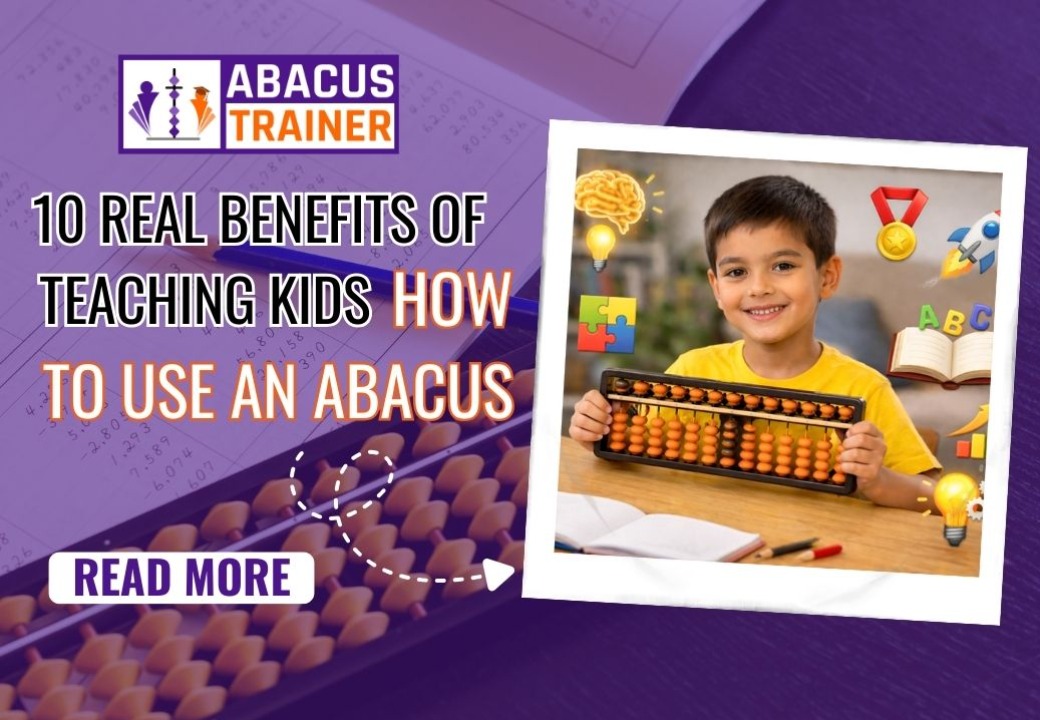
10 Real Benefits of Teaching Kids How to Use an Abacus
How abacus training boosts your child’s brain power and focus In today's competitive world, parents are always looking for ways to help their kids get smarter, stay focused, and do better in school. One very effective method is training with an abacus. Many parents first want to know what abacus training is before they can understand its effects.
What is the purpose of Abacus Training?
Children learn how to do math with an abacus, which is a counting tool made of beads, in a structured program called abacus training.
At the beginning, children use a real abacus and move the beads to solve simple math problems like addition and subtraction. As they practice more, they start imagining the abacus in their mind and solve calculations without using the actual tool. This stage is called mental math or mental abacus.
So, if someone asks you what abacus training is, the short answer is:
Using beads to improve memory, focus, calculation speed, and logical thinking is a way to help the brain grow.
Now, let's look at the ten benefits that are known to be true.
1. Makes calculations faster
One of the best things about learning the abacus is that it makes calculations faster. Kids who learn how to use an abacus can solve math problems much faster than kids who only use traditional methods.
If children practice regularly, they can:
- Quickly add and subtract multi-digit numbers
- Perform calculations in their head
- Reduce hesitation while solving problems during tests
Because of this speed and accuracy, they gain a strong academic advantage.
2. Helps you remember things better
Abacus training helps kids remember things better because they have to remember where the beads are and how the numbers fit together while they work on their math problems.
As children visualize numbers in their mind:
- Their short-term memory improves
- Long-term memory becomes stronger
- Their overall ability to remember information increases
This improved memory also helps them perform better in other subjects like language and science.
3. Improves focus and concentration
Kids have to pay close attention to using an abacus to do math. Even a little distraction can cause mistakes.
Training with an abacus on a regular basis:
- Makes you pay attention longer
- Makes it easier to listen
- Cuts down on mistakes made without thinking
- Children do better in school when they can pay attention better.
4. Improves number sense
A strong understanding of numbers is another big benefit of learning the abacus. Kids don't memorize formulas; they learn how numbers work.
They learn:
- Make sure the place values are clear.
- Combinations of numbers
- Calculations that make sense step by step
- This gives you a strong base in math.
5. Activates Both Sides of the Brain
Abacus training is unique because it engages both sides of the brain.
- The left side of the brain handles logic and mathematical calculations.
- The right side of the brain is responsible for imagination and visualization.
When children visualize the abacus in their mind while solving problems, both sides of the brain work together. This balanced stimulation supports overall brain development.
6. Increases Confidence in Math
A lot of kids are scared of math when they're young. Training with an abacus makes math easier and more fun.
When kids:
- Quickly solve problems
- Get the right answers
- Take part in contests
Their confidence grows on its own. This gets rid of math anxiety and makes people want to learn.
7. Makes you better at listening
In many abacus classes, teachers give numbers verbally for practice. Children listen carefully and solve the calculations in their mind without writing anything down.
This makes things better:
- Listening actively
- Quick processing of information
- Ability to respond quickly
These skills are helpful for learning in school and talking to people every day.
8. Helps you think analytically and logically
It's not just about speed when you learn how to use an abacus. It also makes logical reasoning stronger.
Kids learn to:
- Divide numbers into smaller pieces
- Step by step, solve problems
- Find patterns
This skill in analysis is useful for advanced math and tests that are hard to pass.
9. Lessens reliance on calculators
A lot of kids these days use calculators or mobile apps to do simple math.
Learning the abacus helps children perform calculations in their mind. Because of this, kids:
- Become able to think for yourself
- Get good at mental math
- Do better on tests faster
This independence boosts confidence in school.
10. Helps students grow in all areas of school
The last and most important benefit of abacus training is that it helps students do better in school overall.
Parents frequently observe:
- Better grades in school
- Better discipline
- More levels of focus
- Better ways to study
Abacus helps kids remember things and focus, which makes them do better in all subjects, not just math.
How old should kids be when they start learning the abacus?
- After learning what abacus training is, a lot of parents want to know when their kids should start.
- The best age is usually between 5 to 7 years.
- At this age, kids' brains are growing quickly, which makes it easier for them to learn new things. Structured abacus training programs can also help older kids, though.
Are there benefits that last a long time?
Yes. Learning how to use an abacus has benefits that last even after kids stop using the tool.
Long-term advantages include:
- Ability to think faster
- Better at making decisions
- Ability to solve problems well
- Better test scores
These skills are helpful in school and even in jobs.
Last Thoughts
In short, learning how to use an abacus is more than just a math exercise. It is a full brain development system that boosts memory, speed, accuracy, focus, and self-esteem.
Now you know that abacus training is a powerful tool that can help a child improve their mental skills. Abacus is one of the best ways for kids to learn new skills because it has so many benefits.
If kids start learning the abacus at the right age, it can help them build a strong academic foundation and become confident, focused, and capable people.