



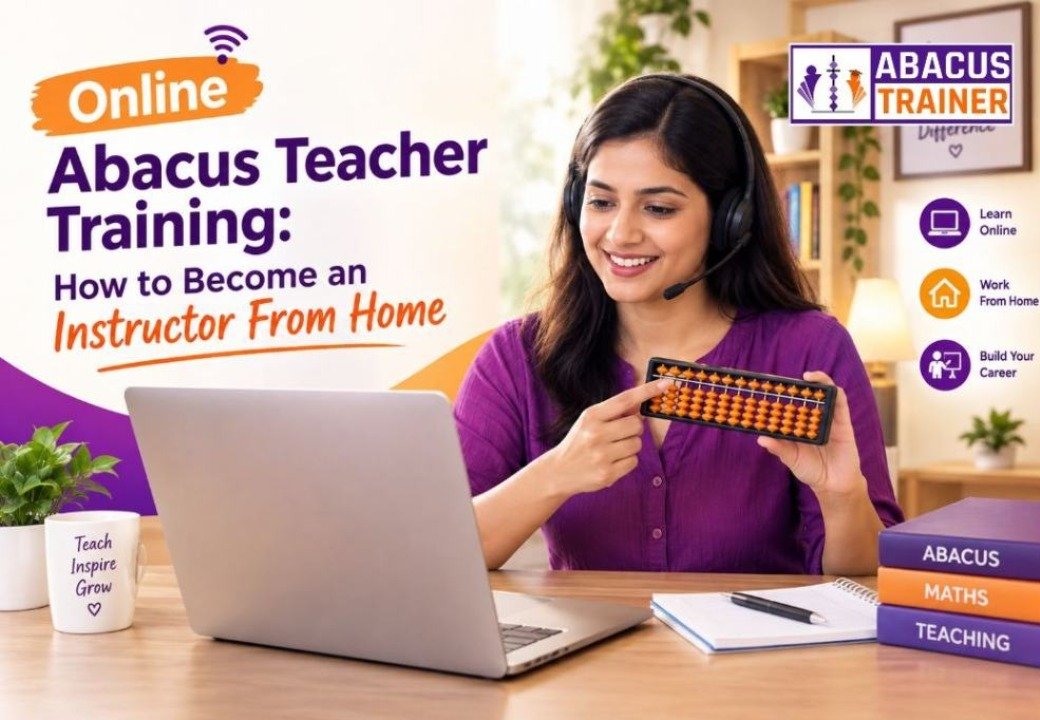
Online Abacus Teacher Training: How to Become an Instructor From Home
Teaching can be a good career for people who enjoy spending time with children. If you also want work that gives you some flexibility, learning to teach abacus can be one option to explore.
You may think that becoming an abacus teacher means going to a training centre every day. That is not always necessary. Online learning has made it possible to learn abacus teaching from home.
With an online abacus teacher training programme, you can learn the basics of abacus, practise different calculations, and understand how to explain them to young learners.
You can usually join the training with a laptop, desktop, tablet, or smartphone. This can make the learning process easier for people who have family responsibilities, another job, or limited time for travel.
Let us understand how online abacus teacher training works and what you can do after completing it.
What Does an Online Abacus Teacher Learn?
Before teaching children, you need to understand the subject yourself.
An online training programme can introduce you to the abacus step by step. You may begin with simple number concepts and later move towards more advanced calculations.
The training can cover areas such as:
- Using an abacus correctly
- Understanding numbers on the abacus
- Moving beads in the correct way
- Addition and subtraction
- Multiplication and division
- Mental calculation
- Different stages of abacus learning
- Teaching techniques
- Student practice
- Lesson preparation
- Handling online or classroom sessions
The exact topics depend on the organisation providing the course.
The important point is that teacher training is different from simply learning abacus. A teacher must know how to take a concept and explain it in a way that a child can understand.
Why Are More People Choosing Online Abacus Training?
Learning online can be useful when travelling to a training centre is difficult.
For example, a person may live far from a training institute or may not be free during regular classroom hours. Online training can remove some of these problems.
Learn Without Leaving Home
You can attend your lessons from your own room.
There is no need to spend time travelling to a training centre for every session. This can be useful for people who live in smaller towns or areas where abacus teacher training is not easily available.
Make Learning Fit Your Routine
People have different daily schedules.
A parent may be busy with children. A working person may only have free time in the evening. A homemaker may prefer studying when household work is finished.
Depending on the programme, online learning may provide live sessions, recorded lessons, or digital study material.
Build a New Skill
You do not have to be an experienced teacher to start learning.
A suitable abacus instructor training programme can help you understand both the subject and the basic teaching process.
This can give you a new skill that you may later use for tutoring or teaching.
Teach From Your Own Space
Once you have completed the required training, you can look into online teaching.
Instead of travelling to students, you may be able to conduct lessons through online platforms. This can make teaching more convenient for both the teacher and students.
Start With a Small Number of Students
You do not need to build a large teaching setup from day one.
You can begin with a few students, understand their learning needs, improve your teaching style, and then decide whether you want to grow your classes.
What Is Covered in an Abacus Instructor Course Online?
Every training provider follows its own syllabus. Still, a complete abacus instructor course online should help you understand the subject as well as the teaching process.
Here are some areas you may come across.
Getting Familiar With the Abacus
The first step is understanding the tool.
You learn what the beads mean and how their position represents numbers. You also practise moving them correctly.
This basic knowledge becomes the foundation for further learning.
Learning Number Operations
After learning the basics, you can practise different mathematical operations.
These may include:
- Adding numbers
- Taking numbers away
- Multiplying numbers
- Dividing numbers
You generally begin with easier examples before working with larger or more difficult calculations.
Moving Towards Mental Calculation
Abacus learning may also include mental maths practice.
Students can gradually learn to picture the abacus in their mind while solving a calculation.
As a teacher, you need to understand this process so that you can guide students properly instead of expecting them to learn it immediately.
Learning to Explain a Topic
A teacher may understand a calculation perfectly but still find it difficult to explain it to a child.
Teacher training can help you learn how to break a topic into smaller steps.
For example, instead of explaining a complete calculation at once, you can show one step, let the child practise it, and then move to the next step.
Planning Lessons
Good classes need some planning.
You may learn how to decide what to teach in a particular session, how much practice to give, and when to introduce a new level.
Simple planning can make lessons easier for both the teacher and the student.
Understanding Student Practice
Children improve through regular practice.
As a teacher, you may need to prepare questions, check answers, identify mistakes, and give additional practice where needed.
Resources such as an abacus worksheet can be useful for regular practice.
Who Can Learn to Become an Abacus Teacher?
Abacus teaching is not limited to people who already work as teachers.
Depending on the eligibility rules of the course, different people may consider this type of training.
It can be suitable for:
- Homemakers
- Parents
- Graduates
- Private tutors
- School teachers
- People interested in education
- People looking for part-time teaching work
- Existing tutors who want to add a new subject
- Individuals interested in online tutoring
- People planning to start small teaching classes
The most important thing is your interest in learning and your willingness to practise.
Before joining any course, check its age, education, experience, or other eligibility conditions.
How Can You Become an Abacus Teacher From Home?
The process does not have to be complicated.
You can take it one step at a time.
Step 1: Look for a Suitable Course
Start by comparing online abacus teacher training programmes.
Do not look only at the course price. Check what you will actually learn.
Look at:
- Syllabus
- Class format
- Course length
- Practice work
- Trainer support
- Assessments
- Certificate
- Study resources
A course that teaches only calculations may not be enough if your goal is to teach children.
Step 2: Learn the Abacus Properly
Spend time understanding the basics.
Do not move to advanced levels simply because you want to finish the course quickly.
As a future teacher, you should feel comfortable solving the questions yourself before asking children to solve them.
Step 3: Improve Your Teaching Style
Next, focus on how you will teach.
Think about the age and level of your students.
A young child may need examples, activities, and repeated practice. Another student may understand the same topic much faster.
Learning to adjust your explanation can make you a better teacher.
Step 4: Practise Regularly
Practice is important for both the teacher and the student.
Use the exercises provided by your training programme. Repeat difficult calculations until you understand them well.
The more comfortable you become with the subject, the easier it can be to teach it.
Step 5: Finish the Required Assessment
Some programmes include assignments, tests, demonstrations, or other assessments.
Complete whatever is required by your training provider.
This can help you check whether you are ready to move forward.
Step 6: Receive Your Certificate
Some organisations offer abacus certification online after successful completion of their course.
The certificate can be useful when you want to show that you have completed formal training.
However, your certificate is not the only thing that matters. Your teaching skills and subject knowledge are equally important.
Step 7: Start Teaching
Once your training is complete, you can explore different options.
You may start with:
- A few private students
- Online tutoring
- Home tuition
- An abacus institute
- Part-time classes
- Freelance teaching
- Your own small batch
If you want to see how abacus classes can be delivered to children through the internet, you can explore online abacus classes for students.
What Skills Should a Good Abacus Teacher Have?
Knowing abacus calculations is important, but teaching requires more than that.
A good teacher should be able to communicate clearly and work patiently with children.
Some useful skills include:
Patience
Not every child understands a concept at the same speed.
You may need to explain the same thing more than once. Staying calm can help the child feel comfortable.
Clear Communication
Use words that children can easily understand.
Avoid making a simple calculation sound complicated.
Regular Practice
Teachers should continue practising their own skills.
This helps them stay confident when students ask questions.
Observation
Pay attention to how a child is learning.
If a student repeatedly makes the same mistake, try a different explanation or give easier examples.
Positive Attitude
Children can lose interest when they feel pressured.
A friendly teaching style can make lessons more comfortable and enjoyable.
Can You Teach Abacus to Children Online?
Yes, online teaching is one possible option after your training.
Online lessons can be conducted through video calls and other learning tools.
However, teaching young children online can be different from teaching adults.
You may need to:
- Keep lessons short and focused
- Use simple explanations
- Ask students questions
- Give regular practice
- Check their work
- Use visual examples
- Encourage participation
- Give breaks when needed
The exact teaching method can depend on the student's age and learning level.
How Can an Abacus Teacher Help Children?
Children can have different strengths and challenges when learning maths.
An abacus teacher can provide regular guidance and practice.
For younger learners, the physical abacus can make numbers more visual and hands-on.
With practice, students can gradually work towards solving calculations mentally.
A teacher can help by:
- Introducing one concept at a time
- Giving easy questions first
- Increasing difficulty slowly
- Checking mistakes
- Repeating difficult topics
- Giving extra practice
- Encouraging independent thinking
- Making lessons interactive
The goal should not be to make every child learn at the same speed.
Instead, the teacher can focus on helping each student understand and improve.
Online and Offline Abacus Teacher Training: Which One Should You Choose?
There is no single choice that is right for everyone.
Your decision can depend on your routine and learning preference.
|
Online Course |
Offline Course |
|
Classes can be attended from home |
Classes take place at a centre |
|
No regular travel to the institute |
Travel may be required |
|
Convenient for people with busy routines |
Fixed classroom environment |
|
Digital resources may be available |
Physical learning resources may be used |
|
Useful when a centre is far away |
Direct interaction with the trainer |
|
Can suit remote learners |
Can suit people who prefer face-to-face learning |
If convenience is important to you, an online course may be easier.
If you learn better through direct classroom interaction, offline training may be a better fit.
What Can You Do After Abacus Teacher Training?
Finishing a course is only the beginning.
Once you have the required skills, you can explore different ways to use them.
Work as an Abacus Teacher
You can look for teaching positions with educational institutes or learning centres.
Become an Online Tutor
Online tutoring can allow you to teach children without travelling to their homes.
Offer Private Classes
You can teach individual students or small groups.
Add Abacus to Your Existing Tuition
If you already provide tuition, learning abacus can allow you to offer another learning option to your students.
Start Your Own Classes
With enough knowledge and experience, you may decide to create your own abacus teaching setup.
Start small, understand your students, and grow gradually.
Your actual opportunities will depend on your experience, teaching skills, location, and the type of work you choose.
Things to Check Before Joining an Online Abacus Teacher Course
Choosing a course is an important decision.
Before paying for training, spend some time checking the details.
1. Course Content
Read the syllabus carefully.
Make sure it covers the areas you want to learn.
2. Training Method
Find out whether classes are live, recorded, or offered in another format.
3. Practice Support
Ask whether practice questions and teaching material are included.
4. Assessments
Check whether you need to take tests or complete assignments.
5. Certificate
Understand whether certification is provided and what you need to do to receive it.
6. Trainer Guidance
Find out whether you can ask questions or receive help during the course.
7. After-Course Support
Some training providers may offer additional guidance after the programme. Check what is included.
8. Course Duration
Do not assume that a shorter course is automatically better.
Look at what is covered during the complete training period.
Frequently Asked Questions
1.Can I learn abacus teaching from home?
Yes. Online training programmes can help you learn abacus concepts and teaching methods without attending a physical training centre.
2. Can a beginner join an online abacus teacher course?
Many programmes start with basic concepts, so beginners may be able to join. However, eligibility requirements differ between training providers.
3. Do I need a teaching degree to become an abacus teacher?
Not necessarily. The requirements depend on the organisation or teaching opportunity. What matters is having the required abacus knowledge and the ability to teach children properly.
4. What is online abacus certification?
It is a certificate provided by a training organisation after you complete the required course and any assessments. The exact certification process depends on the provider.
5. Can I teach abacus to students online?
Yes. After completing suitable training, you can explore online teaching opportunities. You will need the right teaching setup and should understand how to keep children engaged during online lessons.
6. Can I teach abacus as a part-time job?
Yes. Depending on your schedule and available opportunities, you can start with a small number of students and gradually increase your teaching work.
7. How much time does abacus teacher training require?
There is no fixed duration for every programme. Course length depends on the syllabus, number of levels, class schedule, and training provider.
Final Thoughts
Learning to teach abacus from home can be a practical option for people who want to develop a new teaching skill.
An online abacus teacher training programme can help you learn the subject, understand teaching methods, practise calculations, and prepare for working with children.
You do not have to start with a large class or a full-time teaching schedule.
You can begin by learning the basics, practising regularly, improving your communication, and understanding how children learn.
Once your training is complete, you can explore online tutoring, private classes, institutes, or your own teaching setup.
The most important thing is to choose your training programme carefully and focus on becoming a teacher who can make learning simple for children.
Ready to Start Learning?
If you enjoy working with children and want to develop a flexible teaching skill, online abacus teacher training can be a good starting point.
Compare the available courses, check their syllabus and certification process, and choose a programme that gives you proper training and practice.
With consistent learning and regular practice, you can work towards becoming a confident abacus instructor and help children become more comfortable with maths.