






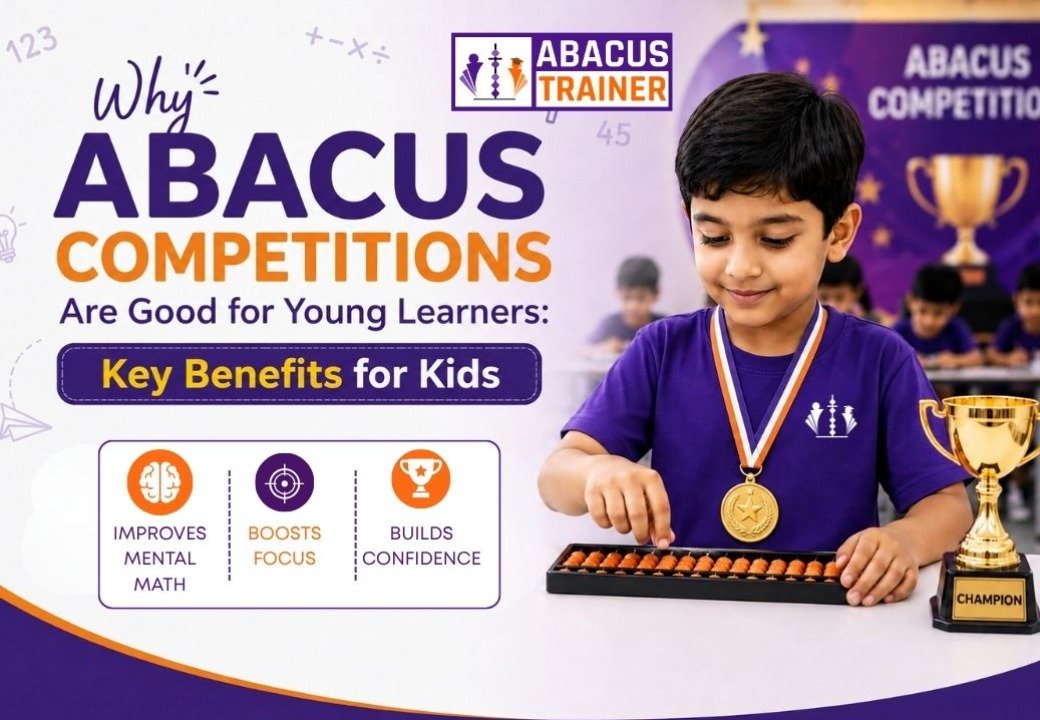
Why Abacus Competitions Are Good for Young Learners: Key Benefits for Kids
Every parent wants their child to become better at maths. But learning maths does not always have to mean sitting with books and solving questions again and again. Children also learn better when they can practise, enjoy, take challenges, and try something new.
This is where abacus competitions for children can be helpful.
An abacus competition gives children a chance to use the skills they learn during their regular abacus classes. They solve maths questions within a set time and try to get as many correct answers as possible.
But the benefits are not only about winning a prize.
The real benefits of abacus competitions include better focus, confidence, speed, accuracy, and comfort with numbers.
Let us look at why abacus competitions can be a good learning experience for children.
What Is an Abacus Competition?
An abacus competition is a maths competition where children solve calculations using the abacus skills they have learned.
Usually, children are given a number of questions and a fixed amount of time to complete them.
They need to work quickly while also making sure their answers are correct.
Abacus competitions can be held online or offline, depending on the organiser.
For children between 5 and 15 years old, competitions can make regular abacus practice more interesting. Children get a chance to use what they have learned in a real competition.
10 Benefits of Abacus Competitions for Young Learners
There are many abacus competition benefits that can help children with both learning and personal growth.
1. Improves Mental Maths Skills
One of the main benefits of abacus for kids is better number skills.
With regular practice, children become more comfortable working with numbers and calculations.
As they learn more, some children can also imagine the abacus in their mind and solve calculations without physically using it.
Competitions give children a chance to use these skills while solving questions within a limited time.
This can help children become more comfortable and confident with mental maths.
2. Helps Improve Calculation Speed
Speed is an important part of an abacus competition.
Children usually have a limited amount of time to answer the questions. This encourages them to solve calculations faster.
With regular practice, children can learn to calculate quickly without losing focus.
However, speed does not improve in one day. It develops slowly through regular practice and patience.
3. Helps Improve Accuracy
Getting the answer quickly is useful, but getting the right answer is even more important.
During an abacus competition, children learn that rushing can lead to mistakes.
They learn to read questions carefully and focus on getting the correct answer.
This is an important part of the abacus learning benefits.
Accuracy is useful not only in competitions but also in school maths and everyday calculations.
Over time, children can learn to balance speed and accuracy.
4. Improves Focus and Concentration
Children need to stay focused while solving questions during a competition.
They need to pay attention to the numbers and continue solving without getting distracted.
Regular practice can help children improve their concentration.
Better focus can also help them in other areas, such as:
Reading
Writing
Science
Homework
School tests
Classroom activities
5. Builds Confidence
Some children understand maths but feel nervous when they have to answer questions in front of others.
Taking part in competitions can help them slowly become more comfortable in such situations.
When children complete questions and see their own improvement, they may start feeling more confident about their abilities.
A child does not have to win to feel successful.
Even participating, trying their best, and improving can be a great achievement.
Parents should focus on their child's effort and progress, rather than only their rank.
6. Teaches Children How to Handle Competition
Competition is a part of everyday life.
Children may experience competition in school, sports, activities, and many other situations.
Abacus competitions can help children learn how to deal with competition in a positive way.
They can learn to:
Stay calm
Follow instructions
Give their best effort
Accept the result
Learn from mistakes
Be happy for other children
Keep trying after a setback
These are some important benefits of competitive learning.
7. Encourages Regular Practice
Sometimes children lose interest when they practise the same thing every day.
An upcoming competition can give them a simple goal to work towards.
For example, knowing that they have a competition coming up may encourage a child to practise their calculations regularly.
However, children should not be forced to practise for many hours.
Short and regular practice sessions are often better for young learners.
8. Teaches Time Management
Time management is another useful skill children can learn through competitions.
When there is a time limit, children need to use their time wisely.
They learn that they should not spend too much time on one question.
This can also help them during school tests and exams, where they need to complete their paper within a fixed time.
9. Makes Maths More Interesting
Some children may feel that maths is difficult or boring.
Abacus activities and competitions can make maths more enjoyable by adding a fun challenge.
Children can enjoy:
Solving questions
Improving their scores
Becoming faster
Learning new skills
Taking part in competitions
Over time, they may start seeing maths in a more positive way.
Instead of thinking:
"Maths is too difficult."
They may start thinking:
"I can get better if I practise."
This positive attitude is one of the long-term benefits of abacus for kids.
10. Helps Children See Their Progress
Every child learns at a different speed.
For one child, success may mean winning a medal.
For another child, success may simply mean getting more answers correct than before.
Competitions give children a chance to see how much they have improved.
They can notice improvements in:
Calculation speed
Accuracy
Focus
Number skills
Confidence
Ability to work under time pressure
Seeing their own progress can encourage children to keep learning and practising.
Why Are Abacus Competitions Important for Children?
The importance of abacus competitions is not only about maths.
A good competition can teach children many useful skills that they may not learn from worksheets alone.
Children get a chance to use their maths skills in a new situation. They also learn how to:
Follow rules
Manage time
Stay focused
Handle pressure
Accept results
Learn from mistakes
For parents, this can be a good way to support both maths learning and personal development.
However, competitions should always be fun and positive.
Children should not feel that they have to win at any cost.
Abacus Competition vs Regular Abacus Practice
Regular practice and competitions both have an important role, but they are different.
Regular abacus practice helps children learn new skills and improve slowly.
Abacus competitions give children a chance to use those skills in a real challenge.
Both can work together.
A simple learning process can be:
Learn → Practise → Improve → Participate → Check Progress → Practise Again
This helps children continue improving step by step.
How Parents Can Support Children Before an Abacus Competition
Parents can make a big difference in how children feel about competitions.
Here are some simple tips.
Keep Practice Short and Regular
Do not make practice stressful.
Encourage your child to practise regularly based on their age and learning level.
Small practice sessions can be easier and more enjoyable.
Focus on Improvement
Instead of always asking:
"Did you win?"
Try asking:
"What did you learn?"
"Did you improve your speed?"
"Which questions were difficult?"
These questions help children focus on learning and progress.
Do Not Compare Your Child With Others
Every child has different strengths and learns at a different speed.
Comparing your child with another child can create unnecessary pressure.
Instead, encourage your child to improve their own previous performance.
Give Them Enough Rest
Children need enough sleep, healthy food, and breaks.
Avoid making them practise for long hours just before the competition.
Too much practice can make children tired or nervous.
Appreciate Their Effort
Whether your child wins a prize or not, appreciate the effort they made.
You can simply say:
"You did your best, and I am proud of you."
Support like this can help children feel confident and motivated.
Are Math Competitions Good for Kids?
Yes, math competitions for kids can be a good learning experience when they are suitable for the child's age and skill level.
They give children a chance to challenge themselves and use their maths skills in a different way.
The mental math competition benefits can include:
Better focus
Faster calculations
Better accuracy
More confidence
Better time management
Greater comfort with numbers
However, competitions should not become stressful.
For young children, the main goal should be to enjoy learning, practise regularly, and improve step by step.
Frequently Asked Questions
1. What are the benefits of abacus competitions for kids?
Abacus competitions can help children improve mental maths, calculation speed, accuracy, focus, confidence, and time management.
They also give children a chance to use their abacus skills in a fun and challenging environment.
2. Are abacus competitions good for children aged 5–15?
Yes. Abacus competitions for children can be useful for kids aged 5–15 when the competition matches their age and skill level.
They can encourage regular practice and help children become more comfortable with numbers.
3. How do abacus competitions improve mental maths?
Abacus competitions encourage children to solve calculations quickly and correctly.
With regular abacus practice, children may learn to imagine the abacus in their mind and solve calculations mentally.
This can support their mental maths skills.
4. Do abacus competitions improve calculation speed?
Yes.
One of the key abacus competition benefits is that children get regular practice solving questions within a fixed time.
This can help them become faster while still focusing on accuracy.
5. Can abacus competitions improve a child's confidence?
Yes.
Taking part in a competition allows children to challenge themselves and see their progress.
Completing questions and participating in competitions can help children become more confident and willing to try new challenges.
6. What do children learn from competitive learning?
The benefits of competitive learning can include:
Better focus
Time management
Discipline
Confidence
Patience
Handling success
Handling setbacks
Learning from mistakes
Children can also learn that regular practice and effort are important for improvement.
7. Should parents focus on winning an abacus competition?
No.
Winning can be exciting, but it should not be the main goal.
Parents should focus on their child's effort, learning, improvement, and confidence.
A positive competition experience is more valuable than simply getting a high rank.
Final Thoughts
The benefits of abacus competitions are about much more than solving maths questions quickly.
For young learners, an abacus competition can help them:
Improve mental maths
Calculate faster
Become more accurate
Improve concentration
Build confidence
Manage time
Handle challenges
Develop a positive attitude towards maths
Most importantly, competitions can teach children that improvement comes with regular practice.
Winning a medal is great, but it is not the only sign of success.
A child who becomes more confident, focused, accurate, and willing to take on challenges is also making valuable progress.
When competitions are organised in a positive and child-friendly way, they can make maths more interesting and give children a learning experience they can use in many other areas of life.
Help Your Child Build Stronger Maths Skills
Looking for a simple and structured way to help your child improve calculation skills, mental maths, speed, and accuracy?
Explore the learning programs and competition opportunities available at AbacusTrainer.
Give your child an opportunity to learn, practise, improve, and take on new challenges in a positive learning environment.