



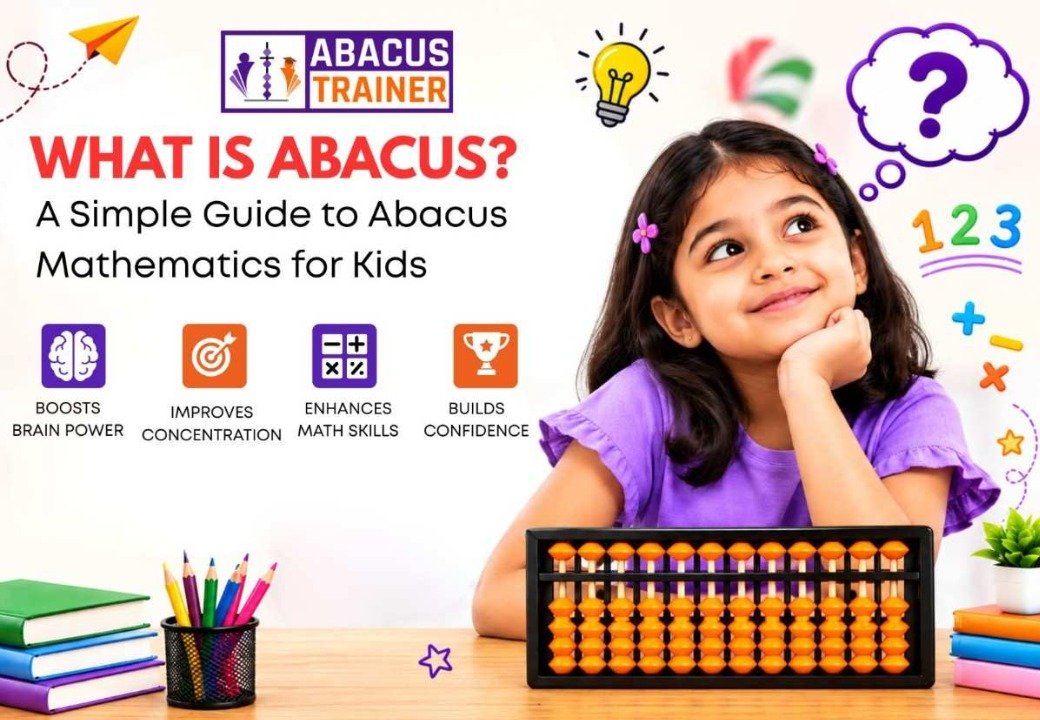
What Is Abacus? A Simple Guide to Abacus Mathematics for Kids
Learn what an abacus is, how Abacus Maths works, its benefits for children, and how it helps improve mental maths, concentration, and confidence. Many parents want their children to get better at maths, but not every child enjoys solving sums on paper. Some children find calculations difficult, while others understand maths but need more time to solve simple problems. This is where Abacus Maths can make learning easier and more engaging for children. If you’ve ever wondered what an abacus is, how it works, or how it can help your child learn maths, this guide explains everything in simple terms.
This is where Abacus Maths can make learning easier and more engaging for children.
If you’ve ever wondered what an abacus is, how it works, or how it can help your child learn maths, this guide explains everything in simple terms.
What Is Abacus?
What exactly is an abacus?
An abacus is a simple learning tool made of rods and beads. Children move the beads to understand numbers and solve maths problems.
Instead of only looking at numbers on paper, children can move and touch the beads to understand numbers. This makes maths more visual, simple, and fun, especially for younger children.
Abacus learning usually starts with basic calculations such as:
- Addition
- Subtraction
- Multiplication
- Division
- Decimal calculations
- Mental calculations
With regular practice, children gradually learn to picture the abacus in their mind. Over time, they can solve calculations mentally without using the physical abacus.
This represents a core concept of abacus mental mathematics.
What is an abacus? Understanding the Basics
Parents often search for terms like “what is an abacus?” or “what is abacus maths?” before choosing a course for their child.
In simple terms, an abacus is a learning tool that helps children understand numbers and maths.
Children first use the beads to solve calculations and, with regular practice, learn to visualize the abacus and calculate mentally.
For example, instead of writing:
25 + 14 = ?
Children who learn Abacus Maths can gradually picture the beads moving in their minds to solve problems.
This practice can help them calculate faster and feel more confident with maths.
What Is an Abacus and How Does It Work?
Another frequent inquiry is what an abacus is.
An abacus is a structure that includes bars with sliding beads. Various bead placements indicate distinct values.
Children learn how to move the beads with their fingers. They learn different ways to represent numbers and use the abacus to solve calculations.
As kids train consistently, they gradually rely less on the physical device.
The learning process generally moves through stages:
Step 1: Learning Numbers
Kids first learn how numbers are represented on an abacus.
Step 2: Learning Basic Calculations
They begin with basic addition and subtraction.
Step 3: Increasing Speed
Through consistent practice, kids answer more problems in a shorter duration.
Step 4: Mental Visualisation
Kids start to visualize the abacus and beads internally.
Step 5: Mental Calculation
Ultimately, they are capable of executing numerous calculations in their heads without relying on the tangible abacus.
This slow progression simplifies learning for kids.
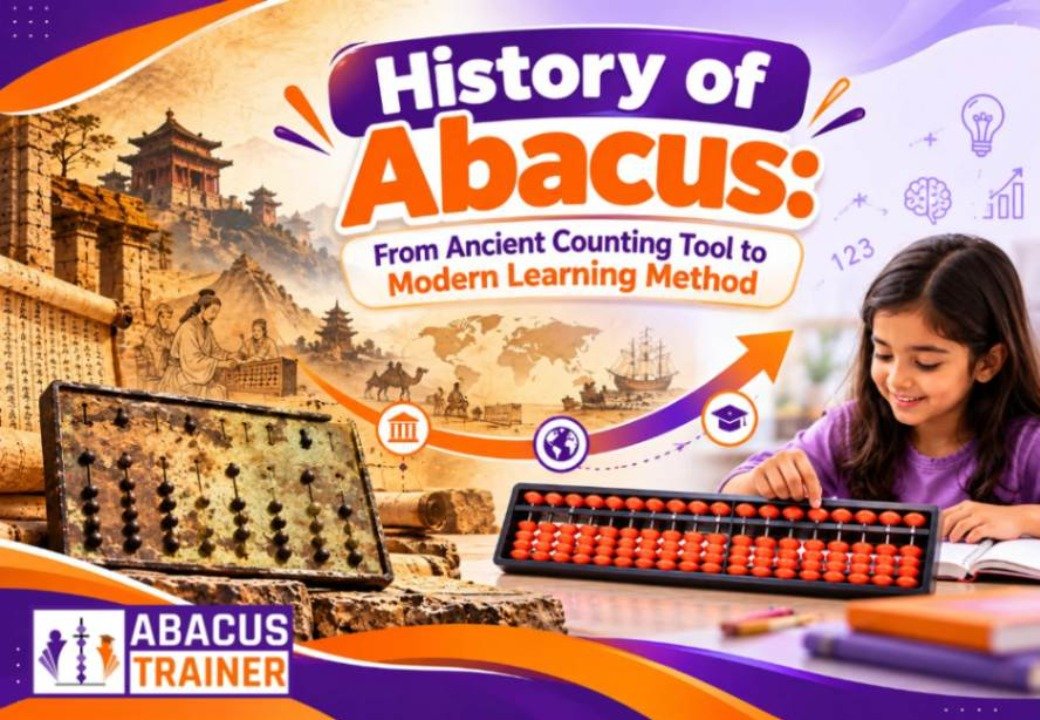
History of the Abacus: From Counting Tool to Learning Method
If you are inquiring about what an abacus is and the origin of this learning device, it has a rich and extensive history.
Various types of counting devices have been utilized by humans for millennia. The abacus emerged as a key instrument for counting and conducting calculations in various areas of Asia, Europe, and beyond.
Before calculators and computers became common, people used tools like the abacus for everyday calculations.
Currently, the abacus is no longer primarily utilized for business calculations. It is commonly utilized as a teaching approach for kids.
Modern abacus programs use the traditional bead method along with regular practice and mental maths exercises.
How Does Abacus Mathematics Help Children?
The primary reason parents opt for abacus classes is not just quicker calculations.
Abacus Maths gives children regular number practice while helping them improve concentration, listening, visualization, and step-by-step thinking.
Here are several typical advantages of learning abacus.
1. Better Calculation Skills
Kids engage in frequent exercises involving addition, subtraction, multiplication, and division.
Regular practice helps children become more comfortable and confident with numbers.
2. Improved Concentration
During an abacus task, kids must focus on the digits and the movement of beads.
This can help children stay focused on one task for a longer time.
3. Mental Maths Practice
A key benefit of learning the abacus is enhancing mental calculation skills.
With regular practice, children can picture the abacus in their minds and solve calculations without moving the beads.
This is referred to as abacus mental math.
4. Better Visualisation
Kids develop the ability to visualize numbers and the locations of beads.
This visual method makes it easier for children to understand and remember numbers.
5. More Confidence in Maths
When kids begin to solve problems accurately and swiftly, they can become more assured in their math skills.
A child who previously stated, "I am not good at math," might gradually gain more confidence with numbers.
6. Regular Practice Builds Accuracy
Abacus learning involves regular practice. Children solve different types of problems and learn from their mistakes.
Eventually, this can assist them in enhancing both their speed and precision.
What Are Abacus Tools?
When parents look for abacus resources, they might be talking about the actual abacus and various educational materials utilized in the learning process.
The simplest tool is an abacus board with sliding beads.
Depending on the learning program, children may also use :
- Practice worksheets
- Number exercises
- Mental calculation activities
- Speed calculation exercises
- Revision exercises
- Online learning tools
- Teacher-guided activities
These tools give children enough practice to understand numbers and do calculations easily.
Abacus Mathematics vs Traditional Maths Learning
Abacus learning is not meant to replace traditional school maths.
Rather, it may serve as a supplementary educational task.
In school, students acquire knowledge on topics like addition, subtraction, multiplication, division, fractions, geometry, and various other mathematical subjects.
Abacus training primarily provides children additional practice with numbers and arithmetic skills.
A child might learn addition at school and then utilize an abacus to practice addition in a distinct and more visual manner.
This combination can make practising numbers more fun and enjoyable for children.
Abacus Vedic Maths: Are They the Same?
Parents often search for Vedic Maths with Abacus because both are popular methods for helping children improve their maths skills.
However, they are not exactly the same.
Abacus learning mainly uses the abacus, moving beads, visualizing numbers, and practising mental maths.
Vedic Maths employs various mathematical methods and shortcuts to perform calculations.
Both can assist children in improving calculation abilities, yet the educational approaches differ.
For younger children, an abacus is a useful starting tool because it helps them understand numbers in a simple, visual, and hands-on way before moving to mental calculations.
Is Abacus Suitable for Children Aged 5–14?
Indeed, kids aged 5 to 14 can gain advantages from organized abacus training.
At this stage, kids are starting to grasp fundamental math ideas in school. Abacus can provide them further practice with numbers in an alternative manner.
Yet, each child progresses at a unique pace.
Certain children might grasp bead movements rapidly, whereas others may require additional practice.
Parents ought to concentrate on consistent education instead of anticipating immediate outcomes.
How Parents Can Support Abacus Learning
Parents can make the learning experience easier by:
- Encouraging regular practice
- Avoiding pressure to be the fastest
- Celebrating small improvements
- Helping children stay consistent
- Asking them to explain how they solved a problem
- Making number practice fun
- Giving children enough time to learn
The goal should be to build a positive relationship with maths.
Can Abacus Help With Mental Maths?
Certainly. Mental arithmetic is a significant aspect of abacus education.
At first, children use a physical abacus. With regular practice, they learn to picture the beads in their minds.
For example, when a teacher gives a calculation, the child may picture the bead movements in their mind instead of moving the beads physically.
This helps children move from using a physical abacus to visualizing it in their minds.
Through consistent practice, kids can gain confidence in performing mental calculations.
Final Thoughts: Is Abacus Worth Learning?
Now that we’ve covered what an abacus is, how it works, and how Abacus Maths helps children practice maths, it is clear that an abacus is more than just a counting tool.
It offers children a visual way to grasp numbers and gradually helps them advance to mental arithmetic.
For children aged 5 to 14, regular abacus practice can improve math skills, concentration, visual thinking, accuracy, and confidence.
Children should enjoy learning and feel comfortable while studying. Maths does not have to be difficult or scary. With the right guidance and regular practice, children can learn numbers in a fun and engaging way.
Ready to Help Your Child Get Better at Maths?
Allow your child to discover abacus mathematics and encounter an alternative method of understanding numbers.
Enroll in an Abacus Maths program now and assist your child in developing enhanced calculation abilities, improved concentration, and increased confidence in mathematics.
Frequently Asked Questions About Abacus Maths
1. What is abacus?
An abacus is a simple learning tool with rods and movable beads that helps children understand numbers and solve maths problems. With regular practice, children can learn to picture the abacus in their minds and solve calculations mentally.
2. What age is best to start learning abacus?
Children between 6 and 12 years can learn abacus. The right age can depend on the child's learning level, interest, and ability to follow instructions.
3. How does abacus help children in maths?
Abacus gives children regular practice with numbers and calculations. It can help improve calculation skills, concentration, accuracy, visualisation, and confidence in maths.
4. Can children do mental maths after learning abacus?
Yes. With regular practice, children can gradually learn to visualize the abacus in their minds and use it to solve calculations without the physical tool.
5. What are the main abacus tools used for learning?
The main tool is the physical abacus with movable beads. Depending on the program, children may also use worksheets, number exercises, mental calculation activities, revision exercises, and online learning tools.
6. Is abacus the same as Vedic Maths?
No. Abacus and Vedic Maths use different learning methods. Abacus focuses on bead movements, number visualization, and mental calculations, while Vedic Maths uses different mathematical techniques and shortcuts.
7. Can abacus improve a child's concentration?
Abacus activities require children to focus on numbers, instructions, and bead movements. Regular practice can help improve their focus and concentration.
8. Does abacus replace school maths?
No. Abacus is generally used as an additional learning activity. It can give children extra practice with numbers and calculations while they continue learning their regular school maths.
9. How long does it take for a child to learn abacus?
The learning time can be different for every child. Regular practice, proper guidance, and the child's learning pace all play a role. Consistent practice is more important than trying to learn everything quickly.
10. Can abacus make maths easier for children?
Abacus can make number practice more visual and hands-on. Children can use beads to understand numbers and calculations before gradually moving towards mental calculation. This can make maths practice more engaging for many children.