






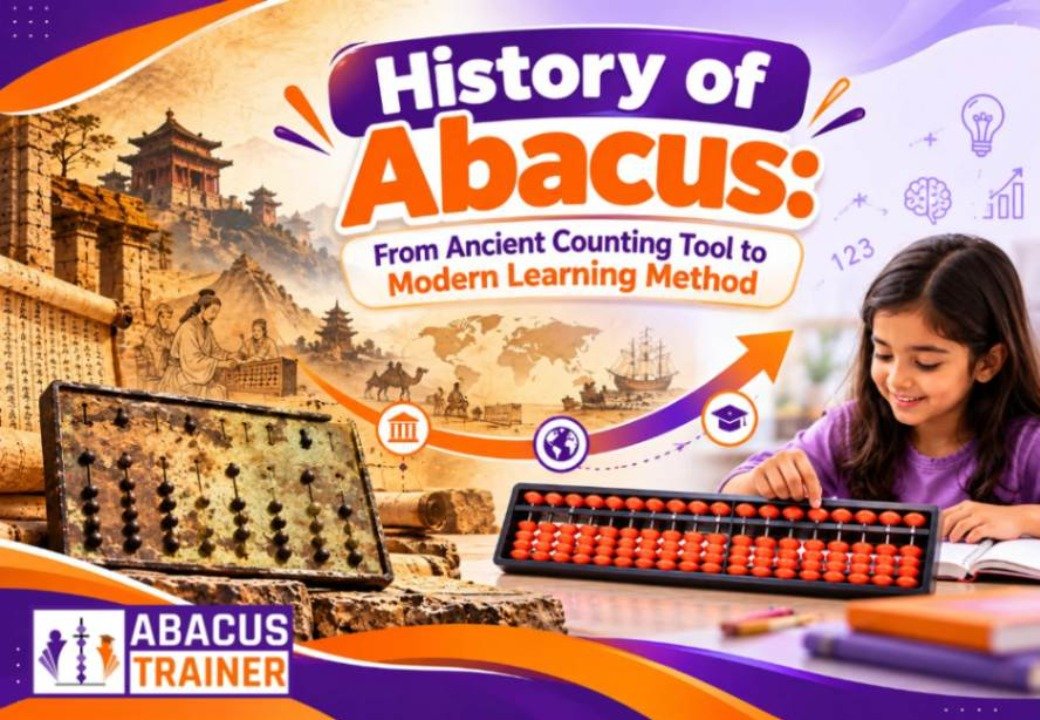
History of Abacus: From Ancient Counting Tool to Modern Learning Method
Today, children use calculators, computers, smartphones, and other digital tools to solve mathematical problems. But people thousands of years ago did not have these technologies.
So, how did people count money, goods, measurements, and numbers?
One of the tools that helped people with counting and calculations was the abacus.
The abacus is one of the oldest calculation tools known to have been used by people. Its basic design is simple. It has a frame, rods, and movable beads or counters. By moving these beads, people could represent numbers and perform calculations.
The history of abacus is a long journey that passed through different cultures and generations. The tool changed over time and developed into different forms in different parts of the world.
What makes the abacus even more interesting is that it is still used today. Modern educators use abacus-based learning to help children understand numbers, practise calculations, and develop important learning skills.
In this blog, we will explore the history and origin of abacus, its development over time, and why this ancient tool is still useful for children today.
What Is an Abacus?
Before exploring the history of the abacus, let us understand what an abacus actually is.
An abacus is a counting and calculation tool made using a frame, rods, and movable beads. The beads can be moved along the rods to represent different numbers.
The position of the beads can represent ones, tens, hundreds, thousands, and more.
For example, instead of simply writing a number on paper, a child can move the beads and visually understand how that number is formed.
This makes the abacus a hands-on maths learning tool.
Children can use an abacus to practise:
- Addition
- Subtraction
- Multiplication
- Division
- Place value
- Number understanding
- Mental calculation
With regular practice, children can also learn to imagine the abacus in their mind and perform calculations mentally.
History of Abacus: Where Did It Come From?
The exact origin of abacus is difficult to identify because there is no single historical record showing where the very first abacus was created.
Before organised counting tools existed, people used simple objects to keep track of numbers and quantities.
These could include:
- Stones
- Seeds
- Small pieces of wood
- Counters
- Marks on surfaces
As communities grew and activities such as trade, buying, selling, and measuring became more common, people needed easier ways to work with numbers.
Simple counting methods gradually developed into more organised counting boards and calculation tools.
This means that the history of abacus is not the story of one person creating the tool on one particular day. Instead, it is a story of how counting methods developed and improved over a long period of time.
The Ancient Abacus
The ancient abacus was not exactly the same as the bead-based abacus children use today.
Early counting methods were much simpler. People could make marks on surfaces such as sand or dust and use these marks to represent quantities.
Later, counters were placed on lines or marked areas of a board. The position of each counter could represent a particular value.
For example, moving a counter to another position could change the value it represented.
These methods made it easier to work with larger numbers and keep track of calculations.
Over time, counting boards became more organised. Counters could be moved along lines or grooves, and eventually, bead-and-rod systems developed.
This gradual development is an important part of the evolution of abacus.
Abacus in Ancient Civilizations
The need for counting was not limited to one country or culture.
Different civilizations developed their own ways of working with numbers and calculations.
Abacus in Greece
Ancient Greeks used counting boards to support mathematical calculations.
One well-known example is the Salamis Tablet, an ancient Greek counting board. It shows how counters could be positioned in different places to represent numbers.
Such tools could be useful for calculations related to trade and everyday activities.
Abacus in Rome
The Romans also used counting devices that involved moving counters along marked lines or grooves.
These tools could help people work with:
- Money
- Trade
- Measurements
- Quantities
Before modern calculation methods became common, physical counting tools provided a practical way to organise numbers.
How Did the Abacus Evolve?
The evolution of abacus happened gradually.
Different versions appeared in different regions, with each design adapted to the needs of its users.
A simple way to understand this development is:
Simple counters → Counting boards → Grooved counting tools → Bead-and-rod abacus → Chinese suanpan → Japanese soroban → Modern educational abacus
The basic idea remained similar throughout this development: objects were moved from one position to another to represent numbers.
However, the design became more organised and practical over time.
This is one of the most interesting parts of abacus history. A simple idea for counting developed into a structured tool that could be used for increasingly complex calculations.
The Abacus in China
China played an important role in the development and use of the abacus.
Different calculation methods were used in China, including counting rods. Over time, the bead-based suanpan became an important calculation tool.
The suanpan consists of a frame, rods, and beads separated by a dividing bar.
It was particularly useful for people who regularly worked with numbers, including:
- Merchants
- Traders
- Accountants
- Business owners
- Shopkeepers
The suanpan allowed users to perform calculations quickly by moving beads instead of writing every calculation step on paper.
The Chinese abacus became an important part of traditional calculation and commercial activities.
The Japanese Abacus: Soroban
The abacus later became popular in Japan, where it developed into the soroban.
The Japanese soroban has a simpler design compared with some earlier versions.
A modern soroban usually includes:
- One bead above the dividing bar
- Four beads below the dividing bar
- Vertical rods
- A surrounding frame
The design was refined over time to make calculations easier and faster.
The Japanese abacus became well known for its use in fast and accurate calculations.
Today, the soroban is also closely connected with abacus education and mental calculation training.
Who Invented the Abacus?
A common question people ask is, “Who invented the abacus?”
The simple answer is that there is no confirmed single inventor of the abacus.
The abacus developed through different counting methods used by people in different civilizations. Early counting boards, counters, and other calculation methods gradually influenced the development of more organised tools.
Instead of thinking of the abacus as an invention created by one person, it is more accurate to think of it as a tool that developed over time.
Different cultures contributed to the development of counting and calculation methods, eventually leading to the different types of abacus we know today.
So, when someone asks who invented the abacus, the most accurate answer is:
The abacus does not have one known inventor. It developed gradually through the counting and calculation methods of different civilizations.
When Was the Abacus Invented?
Another common question is, “When was the abacus invented?”
There is no single confirmed date for the invention of the abacus.
People used counting objects and early calculation methods thousands of years ago. However, these early tools were different from the bead-based abacus used today.
The development happened gradually. Simple counters and counting boards came first, followed by more organised systems and eventually bead-based designs.
Different forms also developed in different regions at different times.
Therefore, instead of giving one exact year, it is better to understand the abacus as the result of a long evolution of counting and calculation tools.
This gradual development is an important part of the history and origin of abacus.
Why Did People Need the Abacus?
Imagine living in a time when calculators and computers did not exist.
A shopkeeper might need to calculate the cost of several products.
A trader might need to count large quantities of goods.
A builder might need to calculate measurements and materials.
An accountant might need to keep track of money.
Doing all these calculations mentally could be difficult.
The abacus provided a simple physical way to organise numbers. By moving beads or counters, users could keep track of calculations and reduce the difficulty of working with numbers mentally.
This made the abacus useful for people involved in business, trade, measurement, and everyday calculations.
From Ancient Calculation to Children's Learning
This is where the story of the abacus becomes especially interesting for parents today.
The abacus was originally used mainly as a calculation tool. Today, it is also used as an educational tool for children.
Modern abacus learning is not simply about moving beads.
Children learn to understand numbers through visual and hands-on activities. They can see how numbers are represented and practise different calculations step by step.
For young learners, this can make maths more interactive.
Instead of only looking at numbers on a worksheet, children can physically move the beads and understand what happens during a calculation.
With regular practice, they can gradually move from using a physical abacus to visualising the abacus mentally.
How Abacus Can Help Children Learn Maths
Children between the ages of 5 and 15 are developing important mathematical skills. Regular practice can help them become more comfortable with numbers and calculations.
Abacus learning can support areas such as:
1. Number Understanding
Children can use beads to understand numbers, quantities, and place value in a visual way.
2. Calculation Practice
Abacus activities give children regular opportunities to practise addition, subtraction, multiplication, and division.
3. Concentration
Children need to focus on the beads, numbers, and calculation steps while practising.
4. Accuracy
Regular practice encourages children to follow calculation steps carefully and check their answers.
5. Mental Calculation
As children become more familiar with the abacus, they can gradually learn to visualise the beads in their minds while solving calculations.
6. Confidence
When children practise regularly and become more comfortable with numbers, they may feel more confident when solving maths problems.
Why Is the Abacus Still Useful in the Digital Age?
Parents may wonder:
“Why should my child learn an old calculation tool when calculators are available?”
The purpose of abacus learning is not to replace calculators.
A calculator can provide an answer quickly. Abacus learning gives children an opportunity to work with numbers themselves.
It encourages children to practise calculations and understand how numbers work.
The abacus also provides a simple, hands-on and screen-free way for children to practise maths.
For young learners, this can make mathematical practice more engaging.
The Modern Abacus for Kids
Today, abacus education has adapted to modern learning methods.
Children can learn through:
- Online abacus classes
- Digital abacus tools
- Worksheets
- Guided practice
- Mental calculation activities
- Level-based courses
- Abacus competitions
Modern programmes combine the traditional concept of the abacus with structured teaching and regular practice.
This shows how an ancient calculation method can continue to have a place in modern education.
The tool may have a long history, but the way children learn with it can continue to evolve.
What Can Parents Learn From the History of Abacus?
The history of abacus shows us that while technology changes, the importance of understanding numbers remains.
Children still need to:
- Understand numbers
- Practise calculations
- Develop concentration
- Improve accuracy
- Build confidence
The abacus provides a simple way to bring these elements together.
Parents do not need to look at the abacus simply as an old-fashioned calculator. It can also be viewed as a learning tool that has remained useful because its basic concept is simple and practical.
Frequently Asked Questions
1. What is the history of the abacus?
The history of the abacus goes back thousands of years. Early counting methods used counters and counting boards, which gradually developed into more organised bead-based calculation tools.
2. Who invented the abacus?
There is no confirmed single inventor of the abacus. It developed gradually through the counting and calculation methods used by different civilizations.
3. When was the abacus invented?
There is no exact date for the invention of the abacus. Early counting methods existed thousands of years ago, while different bead-based forms developed later.
4. Where did the abacus originate?
The exact origin of the abacus is not known. Different types of counting tools developed in different parts of the ancient world and later evolved into various forms of abacus.
5. What was the ancient abacus used for?
Ancient counting tools were mainly used for counting and calculations. Traders, merchants, builders, and other people working with numbers could use them to manage quantities, money, and measurements.
6. How has the abacus changed over time?
The abacus evolved from simple counting methods and boards into bead-based tools. Different regions developed their own designs, including the Chinese suanpan and Japanese soroban.
7. Is the abacus still useful for children?
Yes. Abacus learning can give children a visual and hands-on way to understand numbers and practise calculations.
8. At what age can children start learning abacus?
Many children can begin learning abacus around the age of 5 or 6, depending on their readiness. Beginners usually start with basic numbers and bead movements before progressing to more advanced calculations.
9. Can abacus learning help with mental calculation?
With regular practice, children can learn to visualise the abacus mentally and use that mental image while performing calculations.
10. Why should parents consider abacus classes for children?
Abacus classes provide structured practice with numbers. They can support calculation practice along with skills such as concentration, accuracy, number understanding, and confidence.
Conclusion
The history and origin of abacus is a fascinating journey through the development of human calculation.
From simple counters and counting boards to the Chinese suanpan and Japanese soroban, the abacus has changed and developed over time.
There is no confirmed single answer to who invented the abacus, and there is no one exact date for when the abacus was invented. Instead, it is better understood as a calculation tool that evolved gradually as people found easier ways to work with numbers.
What began as a practical calculation method has now become a learning approach for children.
For young learners, the abacus can make numbers more visual, interactive, and hands-on. With regular practice, children can work on calculation skills while developing concentration, accuracy, and confidence.
The long history of abacus reminds us that a simple learning tool can remain valuable even as technology continues to change.
Help Your Child Start Learning Abacus
Want to introduce your child to a simple and structured way to practise maths?
Explore AbacusTrainer's online abacus classes and give your child an opportunity to learn calculations through guided practice and modern learning methods.
Start your child's abacus learning journey with AbacusTrainer today!