



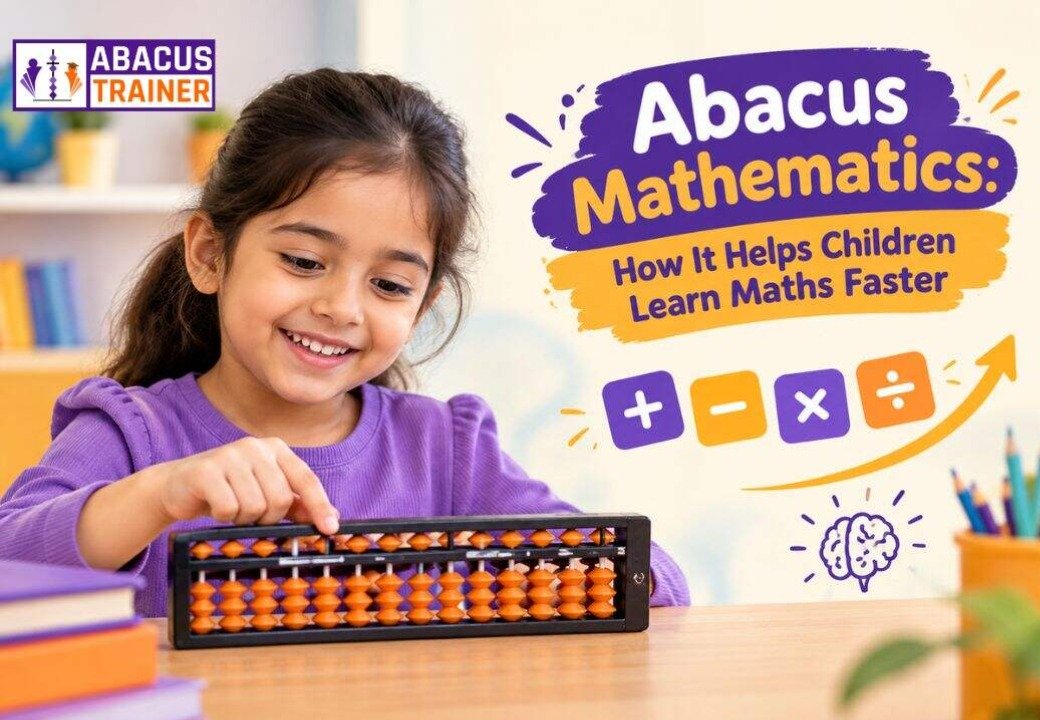
Abacus Mathematics: How It Helps Children Learn Maths Faster
Maths is an important part of every child’s education. But some children may find numbers, calculations, and formulas difficult or boring. Because of this, many parents look for simple and fun ways to help their children learn maths.
This is where abacus mathematics can be helpful.
Abacus learning uses a simple tool with beads to teach children numbers and calculations. With regular practice, children can slowly learn to imagine the beads in their minds and solve calculations without using the physical abacus.
This way of learning can make maths more interesting and help children improve skills like focus, speed, memory, and confidence.
For children between 5 and 15 years old, abacus can be a fun way to build strong basic maths skills.
What Is Abacus Mathematics?
Abacus mathematics is a way of learning numbers and calculations with the help of an abacus.
An abacus is a simple tool made of rods and beads. Children move the beads to show numbers and solve different calculations.
Instead of only memorising maths rules, children can see and understand how numbers work.
For example, when learning addition, a child can move the beads to add two numbers together. With regular practice, children start understanding number patterns and calculations more easily.
After practising for some time, children can also learn mental abacus. This means they can imagine the abacus in their mind and solve calculations without physically moving the beads.
How Does Abacus Math Work?
The basic idea behind abacus math is simple.
First, children learn how numbers are shown on the abacus. Then, they slowly learn different types of calculations, such as:
- Addition
- Subtraction
- Multiplication
- Division
- Simple number combinations
As children practise regularly, they can become more comfortable and faster at solving calculations.
The purpose of abacus learning is not only to improve calculation speed. It can also help children understand numbers better, stay focused, and feel more confident when solving maths problems.
Why Is Abacus Maths for Kids Useful?
Every child learns differently. Some children understand numbers better when they can see and touch something instead of only reading numbers from a book.
Abacus maths for kids makes learning more visual and hands-on.
Here are some of its important benefits.
1. Helps Children Calculate Faster
One of the main benefits of abacus learning is that it can help children improve their calculation speed.
Children regularly practise different calculations using the abacus. Over time, they become more familiar with numbers and can solve simple problems faster.
This can be useful during school maths tests and in everyday situations where quick calculations are needed.
2. Builds Strong Mental Math Skills
Abacus learning can help children develop mental math skills.
After enough practice, children learn to imagine the abacus in their minds. They can then imagine moving the beads to solve calculations.
This can reduce the need to write down every step of a simple calculation.
With regular practice, children can become more comfortable with doing maths in their heads.
3. Improves Concentration
Abacus activities require children to pay attention to numbers and bead movements.
They need to listen carefully, remember numbers, and follow the correct steps.
Regular practice can help children improve their ability to focus on one task.
Better concentration may also help them while studying other school subjects.
4. Supports Memory Development
While using an abacus, children need to remember numbers, steps, and bead positions.
When they start using mental abacus techniques, they also need to imagine the abacus in their minds.
Using memory and visualisation together can help children practise their ability to remember and recall information.
5. Makes Maths More Interesting
Many children find maths difficult because they see it as only solving questions from a textbook.
Abacus learning gives children something practical to use.
Moving beads and watching numbers change can make maths more fun and interactive. Instead of only completing worksheets, children can learn through an activity.
This can help children develop a more positive attitude towards maths.
Abacus Mathematics for Kids: What Can Children Learn?
Abacus mathematics for kids is usually taught step by step.
Children normally start with simple number concepts and slowly move towards more difficult calculations.
Beginners
At the beginning, children may learn:
- Number recognition
- Counting
- Place value
- Basic addition
- Basic subtraction
- How to use the abacus
Intermediate Learners
As children improve, they can move on to:
- Faster addition and subtraction
- Multiplication
- Division
- Working with larger numbers
- Mental calculations
Advanced Learners
With regular practice, children may work on:
- Faster mental calculations
- More complex number combinations
- Improving calculation speed
- Mental abacus exercises
- Timed calculation activities
Every child learns at a different speed. Regular practice is more important than trying to finish each level quickly.
How Abacus Calculation Helps in Daily Learning
Abacus calculation is not useful only during abacus classes.
The skills children practise can also support their regular maths learning.
For example, children may become more comfortable with:
- Basic arithmetic
- Comparing numbers
- Addition and subtraction
- Multiplication tables
- Mental calculations
- Solving maths questions
When children become comfortable with basic calculations, they may be able to spend more time understanding what a maths question is asking instead of focusing only on the calculation.
Abacus Arithmetic vs Traditional Maths Learning
Traditional maths learning is important and should not be replaced by abacus training.
Instead, abacus learning can be used as an extra way to support a child’s maths skills.
Traditional maths often focuses on formulas, written calculations, and problem-solving.
Abacus arithmetic gives children a more visual and practical way to learn about numbers and calculations.
Using both methods can give children a balanced way to learn maths.
How Parents Can Support Abacus Learning at Home
Parents do not need to be maths experts to help their children practise abacus.
A few simple habits can make learning easier and more enjoyable:
- Encourage short and regular practice.
- Make learning fun instead of putting pressure on the child.
- Praise improvement, not just correct answers.
- Give children enough time to understand new topics.
- Avoid comparing your child with other children.
- Encourage simple mental calculations during everyday activities.
For example, while shopping, you can ask your child to add the prices of two items. You can also ask them how many items are left after some are removed.
Small activities like these can make maths practice feel natural and fun.
Is Abacus Suitable for Every Child?
Abacus can be useful for many children, especially children who enjoy visual and activity-based learning.
However, every child learns differently and at their own pace.
Some children may understand bead movements quickly, while others may need more time and practice.
Parents should focus on steady progress instead of expecting quick results.
The main goal should be to help children feel comfortable with numbers and enjoy learning maths.
When Should Children Start Learning Abacus?
Children can start learning abacus when they are comfortable with basic numbers and can follow simple instructions.
For many children, ages 5 to 15 can be a good time to build strong number and calculation skills.
Starting early gives children more time to practise and improve their skills step by step.
However, age is not the only important factor. A child’s interest, readiness, and regular practice also matter.
Frequently Asked Questions
1. What is abacus mathematics?
Abacus mathematics is a way of learning numbers and calculations using an abacus. Children use beads to understand numbers and solve calculations.
2. Is abacus math good for kids?
Yes. Abacus math can help children practise calculation, concentration, memory, visualisation, and number skills in a fun and engaging way.
3. What age is best for abacus maths for kids?
Children between 5 and 15 years old can benefit from abacus learning. However, the best age to start depends on the child’s interest and readiness to learn numbers.
4. Can abacus improve mental math?
Regular abacus practice can support mental maths skills. Children learn to imagine the abacus and use this mental picture to solve calculations.
5. Does abacus help children calculate faster?
With regular practice, children can become faster at basic calculations. Speed usually improves slowly as their understanding and confidence grow.
6. What is mental abacus?
Mental abacus means imagining the abacus in your mind instead of physically using the beads. Children use this mental image to solve calculations.
7. Is abacus better than traditional maths?
Abacus and traditional maths have different purposes.
Abacus can be used as an additional learning method to improve calculation and number skills. Traditional maths helps children learn wider mathematical concepts and problem-solving skills.
Using both can give children a well-rounded maths learning experience.
8. How much should a child practise abacus?
Short and regular practice is usually better than long and tiring sessions.
Parents can follow the practice routine suggested by their child’s trainer.
Conclusion
Abacus mathematics gives children a different and fun way to learn numbers.
By using beads, visualisation, and regular practice, children can work on skills such as calculation speed, concentration, memory, and mental maths.
For parents of children aged 5-15, abacus can be a useful addition to regular maths learning.
The most important thing is to make practice regular, positive, and enjoyable.
Every child learns at a different pace. So, the focus should be on understanding, practice, and confidence, rather than only on speed.
Help Your Child Build Strong Maths Skills
Want to help your child feel more confident with numbers and calculations?
Explore the learning programs at AbacusTrainer and give your child a fun and engaging way to practise maths skills.