







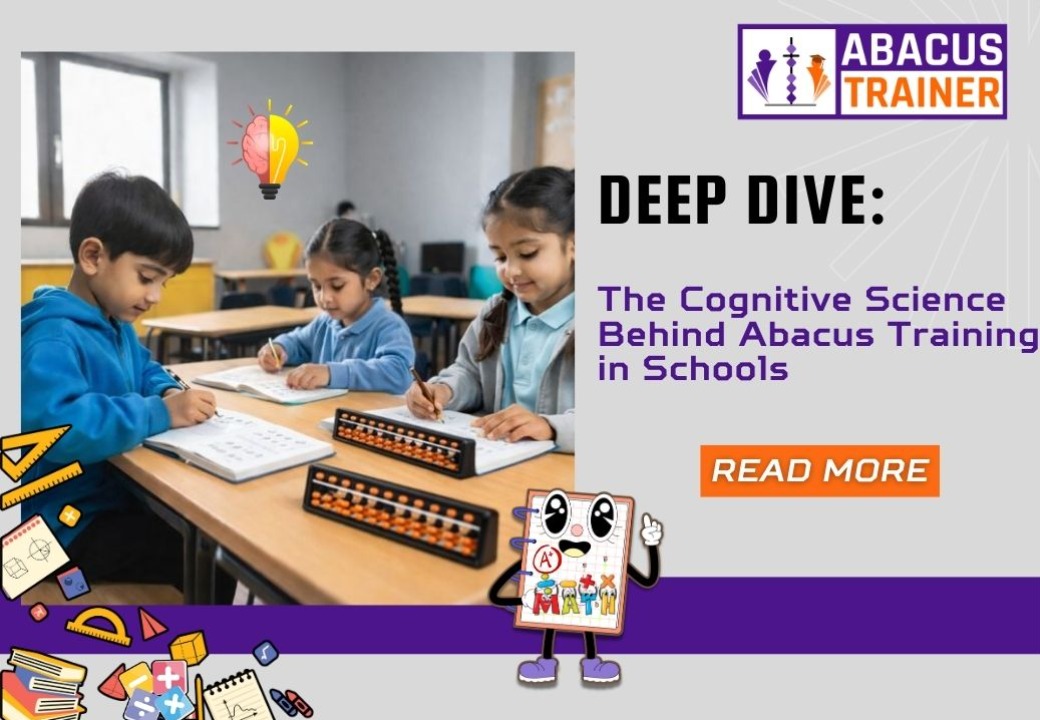
Deep Dive: The Cognitive Science Behind Abacus Training in Schools
In the abacus that students use to learn mathematics, they don’t just move the beads; they visualise every calculation. At first, children observe the beads moving along rods. Sooner still, they are closing their eyes and “seeing” those beads in their mind’s eye, solving problems without touching the frame. It’s an awesome trick that taps into the brain’s visuospatial sketchpad (the area it uses to hold mental images), making it easy for them to juggle those multi-step calculations. Over time, that mental abacus grows ever more distinct, and something as mundane as a question about addition or subtraction begins to seem less like engaging in the calculations of a complex arithmetic problem and more like remembering a picture.
Fingers and Brain: Building Number Sense
Long before the calculator, our fingers were our first counting tool. It’s the ancient skill of finger counting, which the Greeks called “finger gnosis”, but the abacus revives it with precision movements: a thumb nudge here, an index-finger flick there. This “abacus math with fingers” practice reinforces neural maps of the concept of number and quantity as children fine-tune those small movements, the brain regions that are home to “how many” grow more precise. Studies even show that students who have good finger awareness tend to be more confident with tricky word problems and estimating, as compared to their peers.
Supercharging Working Memory
Every time a child solves “48 + 27,” they must:
- Remember the units sum (8 + 7 = 15),
- Keep track of the carry-over “1,”
- Add the tens digits (4 + 2 + 1) in one swift mental move.
This juggling act stretches the working memory “scratchpad,” making it sturdier for all subjects. Whether interpreting a complex abacus question or following a multi-step science experiment, students trained on the abacus can hold and manipulate more pieces of information at once. That boosted capacity not only speeds up math but also improves reading comprehension and problem-solving across the curriculum.
Real-World Classroom Tips
Bringing these cognitive benefits into your school doesn’t require hours of daily drills. Here’s how to start:
- Begin with Fingers: Spend two weeks on finger-counting games tapping, tracing, and naming each finger to prime the brain’s motor and number centres.
- Introduce the Frame: Move to real beads only after finger mastery. Focus first on single-digit addition, ensuring children fully grasp how one bead shift equals one unit.
- Encourage Mental Practice: Ask students to close their eyes and imagine shifting beads before they touch the abacus. That bridges the gap between physical movement and mental imagery.
- Short, Daily Sessions: Even 10 minutes a day of targeted abacus drills builds strong neural connections. Consistency is more powerful than marathon sessions.
- Use Story Problems: Frame calculations as real-life puzzles“If Sara has 37 marbles and wins 26 more, how many does she have?” so students see how abacus training solves everyday math questions.
Why It Works
Neuroimaging studies of expert abacus users reveal thicker connections between the frontal lobes (planning and strategy) and the parietal lobes (number processing). Myelin the insulating sheath around nerve fibres grows along these pathways with practice, making mental signals travel faster. As a result, calculations shift from slow, effortful steps to near-automatic responses, freeing up cognitive energy for problem-solving and creative thinking.
Conclusion
Abacus training is far more than a niche enrichment activity; it's a scientifically proven way to rewire young brains for stronger memory, sharper attention, and lightning-fast arithmetic. By blending vivid mental imagery, precise finger workouts, and structured practice, schools can unlock each child’s full mathematical potential. Start small, stay consistent, and watch your students tackle even the toughest abacus question with confidence and a smile.