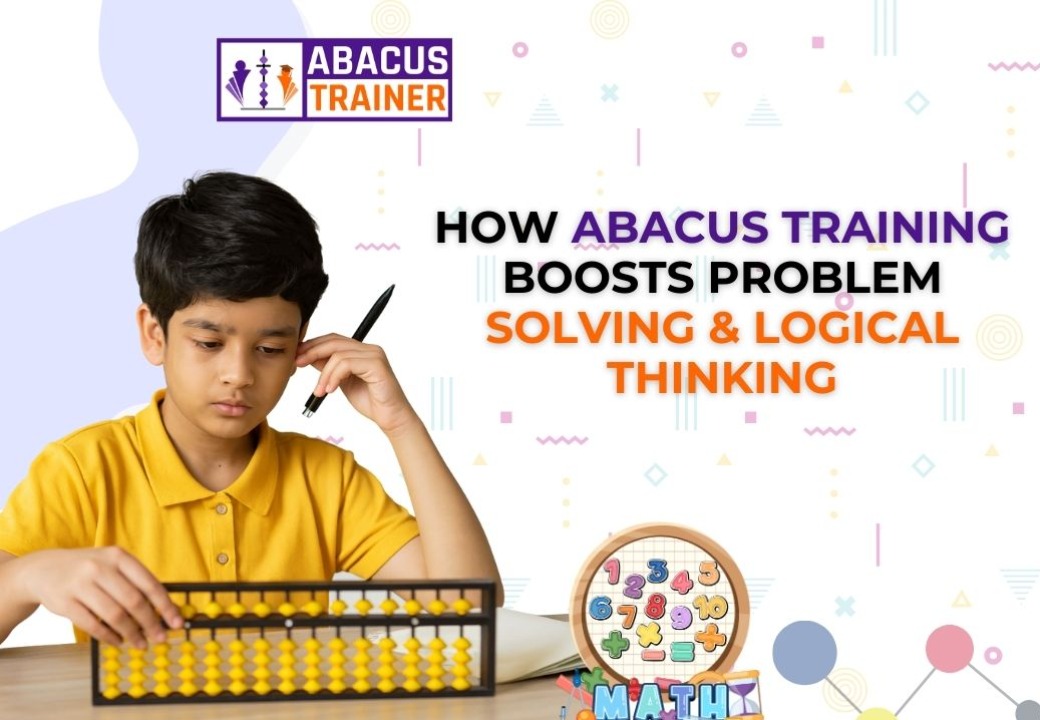
How Abacus Training Improves Problem Solving & Logical Thinking
When most people?think abacus training, they think of children sliding beads through rows to add and subtract quickly. But the fact is, abacus is not only a shortcut to fast calculations it’s an?entire brain-development system. Constant practicing of abacus, will make your child has stronger memory, more intensive steady focus power and clearer think ability with sound improvements Children who practice with our abacus regularly begin to show fantastic enhancements in their skill level,?not just in lessons but also when facing daily challenges.
But what is equally important, and probably not getting enough attention, are the underlying benefits of abacus that enhance problem-solving skills and logical reasoning, which in turn play a pivotal role in determining a child’s performance at school and while making real-life decisions. Indeed, abacus learning is now widely regarded as a tool for overall cognitive development by many researchers and educators today.
1. Abacus turns numbers into visual understanding
Children often struggle with math because numbers feel abstract. They can’t “see” what is happening during a calculation. Abacus changes this completely.
With every bead movement, children convert numbers into real, physical actions. Over time, their brain begins to automatically visualise bead positions even when the physical abacus is not in front of them. This
visual representation helps them understand:
- number patterns
- number relationships
- sequence and order
- Cause effect logic
This visual logic becomes the background for stronger reasoning skills. For example, a child who understands how bead movement changes value learns to analyse why something increases or decreases a basic principle of analytical thinking.
2. Abacus builds step-by-step problem breakdown
Any big problem becomes manageable when it is broken into smaller parts. This is exactly how the abacus works. To solve even one calculation, the child must:
- observe
- analyse
- choose a method
- move beads correctly
- verify the answer
This step-wise process trains the brain to think in order. It builds a habit of structured thinking, which is essential for:
- solving puzzles
- handling reasoning questions
- understanding maths steps
- organising thoughts in writing and speaking
In short, abacus converts the child’s mind into an organised system where every problem is handled calmly and logically.
Many brain-development studies have found that abacus learners activate both the left brain (logic) and the right brain (visualisation) at the same time.
A well-known study by researchers at Zhejiang University found that children trained in abacus mental maths showed:
- stronger neural connections
- higher activity in visual processing regions
- faster cognitive responses
- This means the brain of an abacus learner becomes more efficient not just in maths, but in thinking overall.
Another research report published in the Journal of Cognitive Neuroscience found that abacus users perform better in:
- working memory
- attention control
- spatial reasoning
- multitasking
These are the same mental skills used in advanced logic, scientific thinking, competitive exams, and real-life decision-making.
Logical thinking requires deep focus. If a child’s mind keeps jumping from one thought to another, they cannot think clearly. Abacus is the most natural form for develop concentration of children, as the child has to:
- pay attention to bead positions
- avoid wrong moves
- follow a method
- maintain a rhythm
The kids really do get better within a few months, and here’s how I’d like to show that, he said:
- longer attention span
- mindfulness of sitting and completing a job
- fewer careless mistakes
- better observation skills
All these enhancements are directly supportive of problem solving.
Practicing an abacus continuously enhances working memory/stretching your working memory is how the brain holds on to information, uses it and builds on it in order to complete a task.
Or, as is sometimes the case, its lack thereof. It’s one of the most reliable predictors of academic achievement. When it comes to practicing on the abacus, children need to recall:
- bead positions
- number sequences
- formulas like little friends and big friends
- multi-step operations
The constant brain exercise strengthens working memory. A child with stronger working memory is able to more quickly solve logical questions, remember steps clearly and process information without being in a mental fog.
Abacus nurtures confidence foundation of fearless thinking
A confident child thinks better. When kids feel they have the ability to solve a problem, they approach it rationally and remain calm doing so. There are many self-confidence building aspects of the ABACUS.
- kids begin to do big numbers fast
- they're quicker than computer in doing mental mathematics
- they are proud of their special skill
- they are doing better in school math
This confidence encourages them to tackle more difficult problems, think outside the box, and become proficient problem solvers. Abacus builds discipline and focus of mind Reasoning isn't a matter of intelligence it's about discipline.
Here is what the abacus learning system teaches kids:
- How to follow instructions
- How to stick to a method
- How to practise regularly
- How to focus without distractions
When children learn abacus, they become mentally stronger. They can deal with hard problems without caving. This stamina is what assists them in acing their exams and also helps them even when they are making decisions in everyday life.
ABACUS: Accelerates pattern recognition at the root of Logic. Lots of puzzles are based on patterns.
For example:
- number sequences
- reasoning questions
- puzzles
- coding basics
When the child practices abacus, they will know numbers by default. Their brains get good at noticing similarities, differences and predictable sequences essential elements of logical thinking.
Conclusion: Abacus builds a child’s logical and problem-solving foundation for life
Abacus is far more than a math tool. It is a training system that
develops the brain at a structural level. Children who practise abacus show improvements in logic, memory, confidence, and reasoning across all subjects, not just mathematics.
By converting number into a visual pattern that the child can work with, abacus shapes how a child thinks, processes, analyzes and does decision making. Be it solving school problems, tricky competitive exam questions or coping with everyday decisions children trained in abacus have an edge.
If you want your children to succeed in school, be sure to teach them abacus and it will surely pay off abacus training is one of the best investments for transactional skills and logical thinking.